Crypto and Sovereignty: feedback on a strategic debate at the Cercle France-Amériques

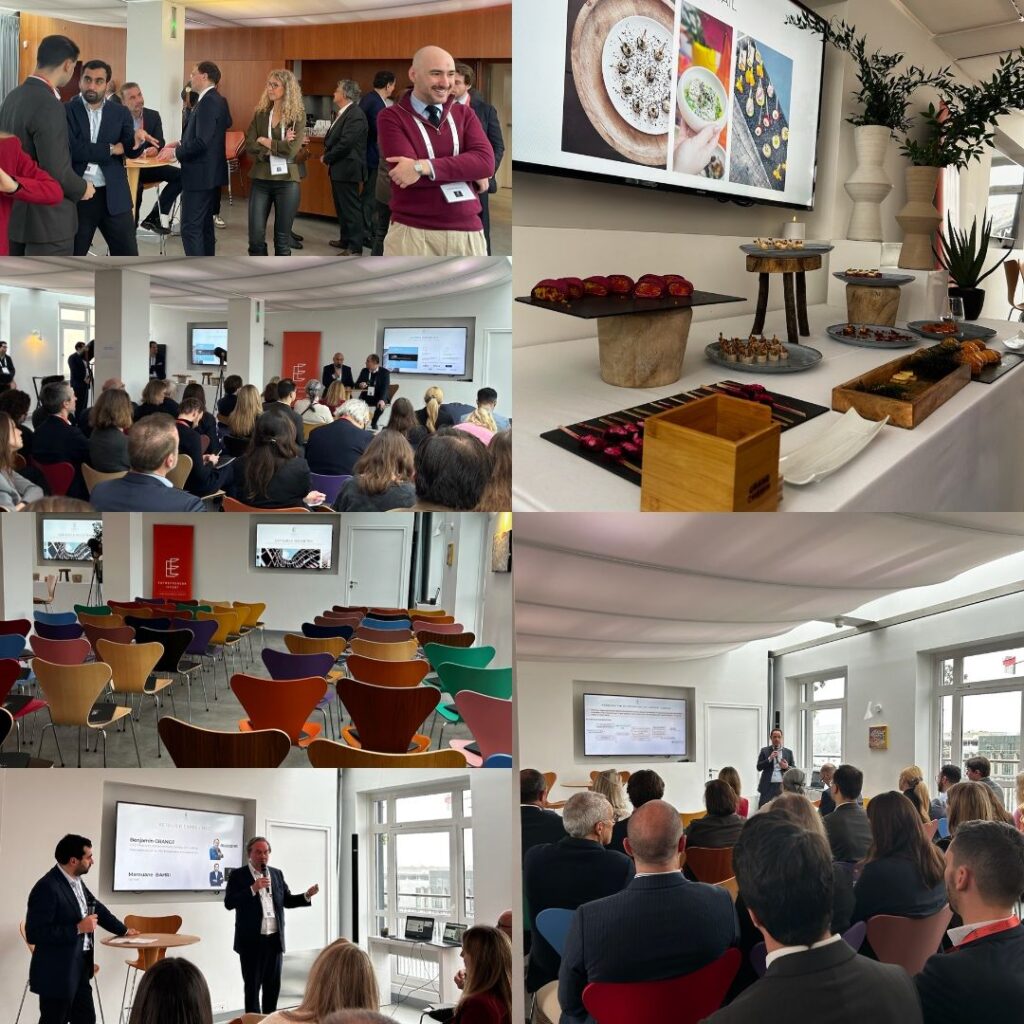
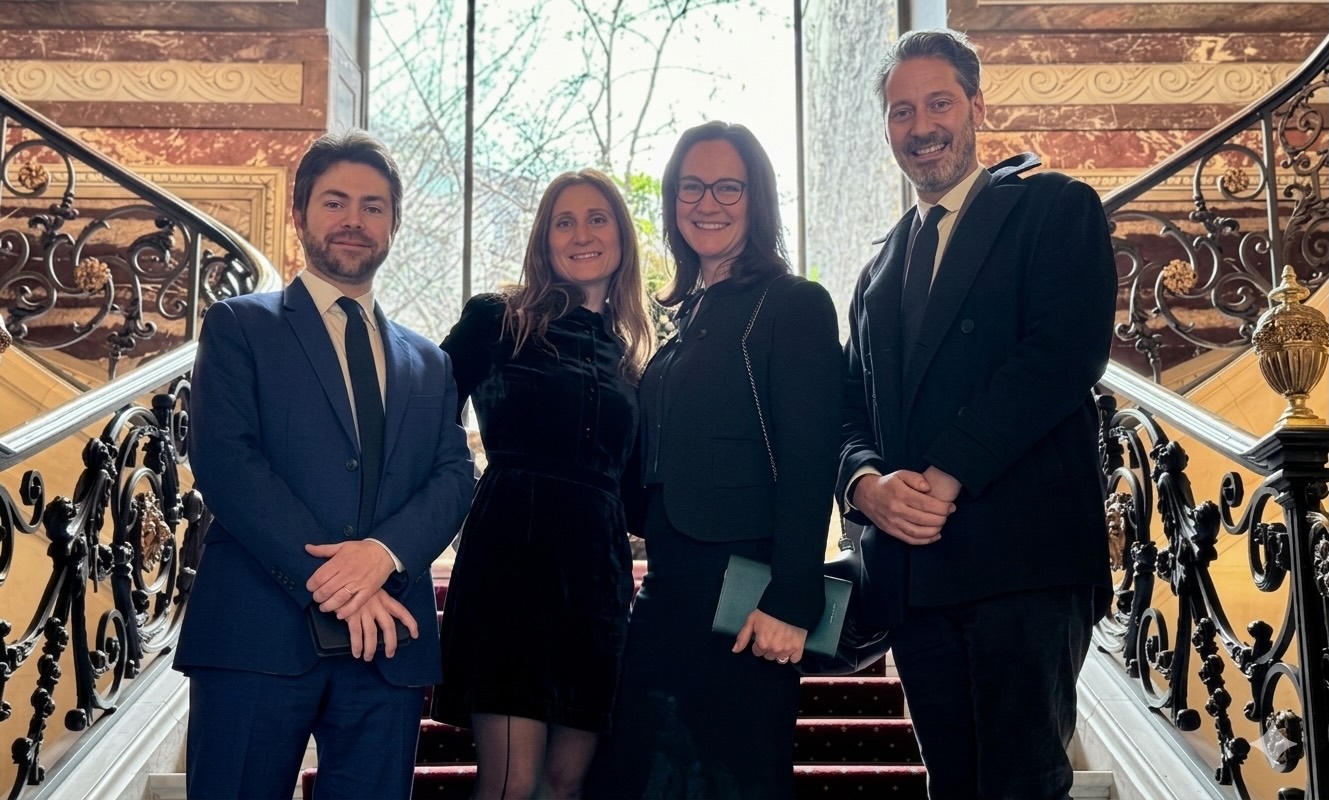
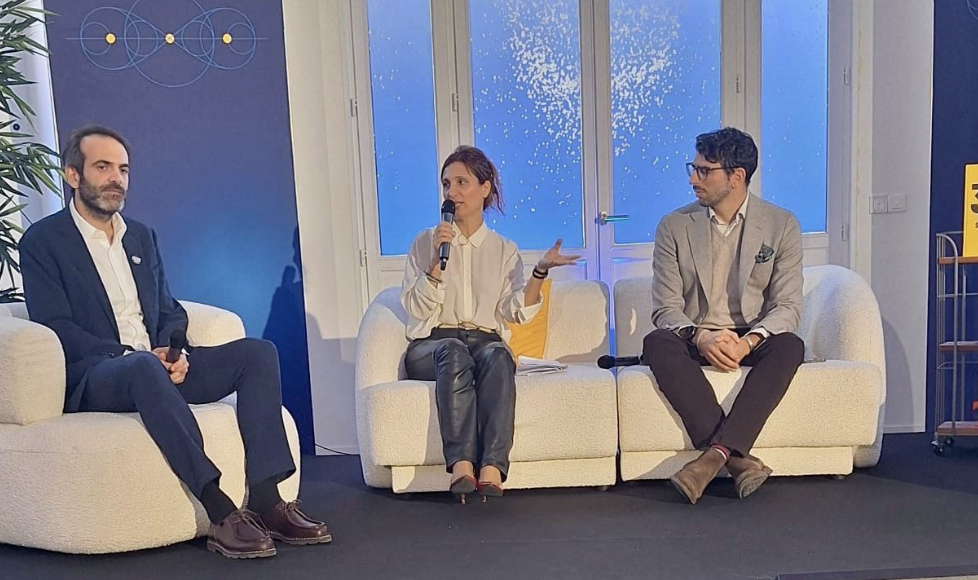
Technological innovation is no longer the only engine of the crypto ecosystem. Today, the debate has moved to the field of legal architecture and financial infrastructure control. This was the heart of the discussion moderated by Laure Pallez, Associate Director at Mascaret, and Estelle Monraisse (President Alter’Com Conseil and Senior Partner at Mascaret) at the conference organized by the Cercle France-Amériques on Monday, March 16, 2026.

The event, dedicated to interactions between “Banks, States, Citizens: who will shape the future of crypto?”, brought together a panel of experts recognized for a cross view between Europe and the United States on the issues of digital sovereignty: Sebastien Badault, Vice-President at Ledger and Stéphane Blemus, Financial Law Lawyer at White & Case.

The observation: irreversible integration

The era of experimentation is over. The question of the entry of digital assets into mainstream finance no longer arises: it is a reality. The current challenge lies in the definition of the rules of the game. The next chapter will not be written by technology alone, but by the interaction between private infrastructure, public sector involvement and regulatory credibility.


Three pillars of transformation identified:

  1. Stablecoins, vectors of influence: For Europe, the ability to develop and adopt local issuers and payment rails is an imperative of sovereignty in the face of a dollar-dominated market.
  2. Asset tokenization: More than a technical innovation, the programmability of financial assets represents a structural overhaul of capital markets, from issuance to asset service.
  3. The regulatory framework as a lever: If the MiCA regulation offers a basis, the leading jurisdictions will be those that will align law, liquidity and institutional adoption to create an ecosystem of sustainable trust.

Finance is emerging at the intersection of law, technology and market structure. For companies and decision-makers, reflection must now focus on the nature of the infrastructure used and the resulting strategic benefits.

Mascaret thanks the Cercle France-Amériques for the invitation to this reference event and its partners for the quality of the debates.

Discover More

Trump 2.0: why must Europe turn American uncertainty into a lever for its Deeptech?

Donald Trump’s return to the White House and the upheavals that accompany it redefine the global technological balance. On the occasion of Deeptech Week, Laure Pallez, Managing Partner Mascaret, spoke at Bpifrance to analyze the consequences of this “American chaos” and the historic opportunities available to the European ecosystem.

Alongside Marco Riccardi (QuoIntelligence) and moderated by David Boujo (Bpifrance), the debate highlighted a paradox: American political instability could become the catalyst for European technological power. Where the United States risks fragmentation of its innovation strategies, Europe can offer a framework of trust, based on legal clarity and continuity of public policies.


Three strategic axes for the European ecosystem:

  1. Attractiveness of talent and capital: Uncertainty can promote a “brain gain” for Europe. To do this, our ecosystems need to simplify access to venture capital and strengthen bridges between research and industry.
  2. The imperative of strategic autonomy: Dependence on American infrastructure is a risk that Europe can no longer ignore. The development of a sovereign Deeptech (AI, cybersecurity, cloud infrastructures) is becoming a top priority for national security.
  3. The transition to the industrial scale: The challenge is no longer to create startups, but to build world leaders capable of competing in global markets while respecting European ethical and regulatory standards.

For Laure Pallez, “chaos is only a chance if we are ready to seize it”. European Deeptech must not simply wait for the storm to pass, but assert itself as the new foundation of global innovation: stable, sovereign and ambitious.

Mascaret supports Deeptech leaders and companies in their positioning and influence strategies within a complex geopolitical environment.

Discover More

When Mascaret speaks: a look back at several weeks of interventions

In recent weeks, Mascaret’s teams have multiplied interventions during strategic events. Back in images and analysis on these highlights, between media decryptions and field expertise. 🎙️


MediaConnect : 03 mars

In an interview with MediaConnect, Stéphanie Laurent was asked about a topic that was too little discussed: how to help your spokespersons better manage stress in front of journalists? Our associate director gives her expert advice in media training, an essential lever to transform apprehension into a communication opportunity. If you want to master media speaking and learn how to manage your stress in interviews, the video is available here.


LCI : 24 février

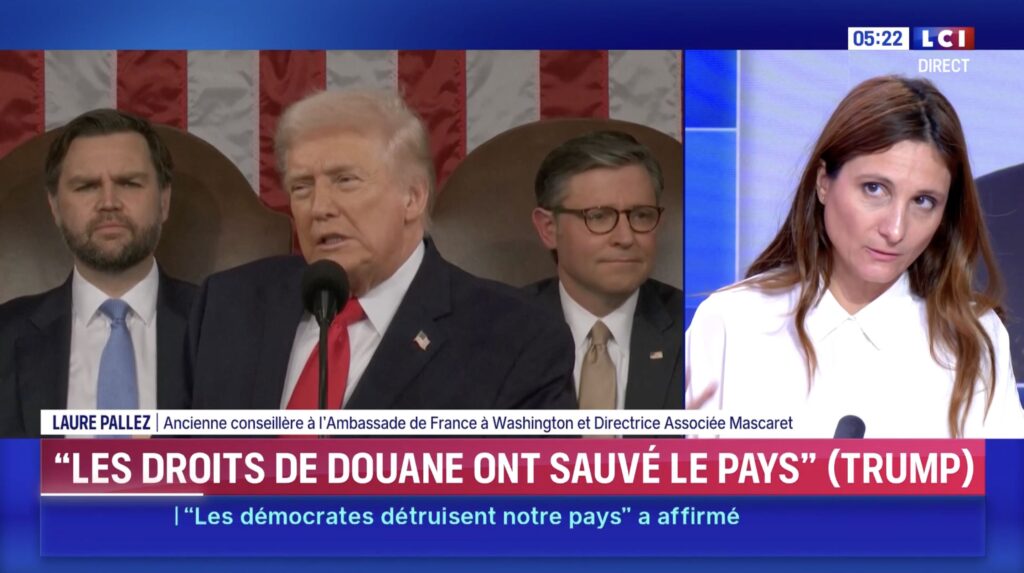
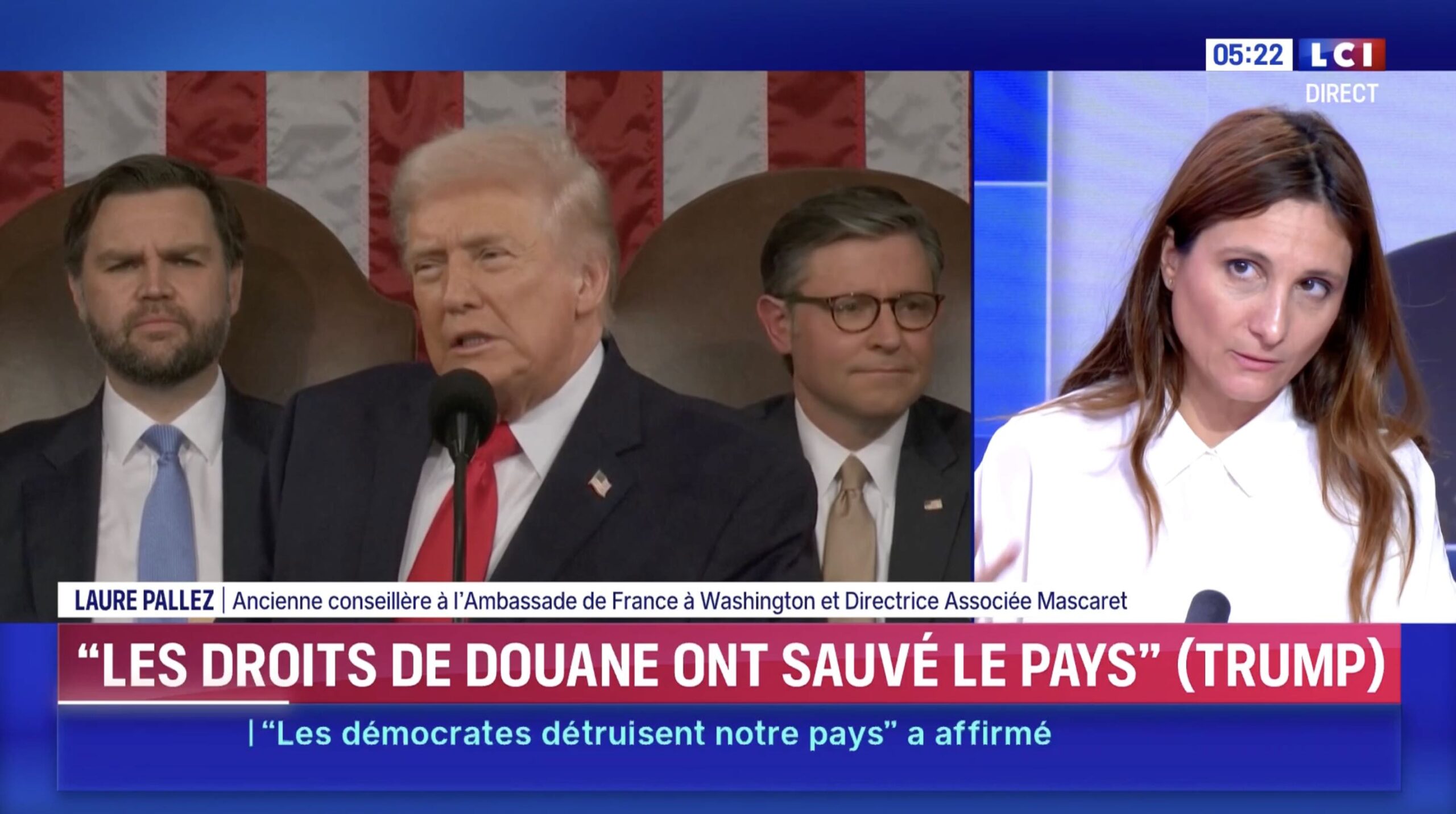
On the occasion of Donald Trump’s State of the Union 2026 speech, Laure Pallez (Senior Partner at Mascaret) spoke on LCI to analyze the substance and form of the presidential address. If the economy and immigration have dominated the debates, a strong signal has been sent: innovation must not be free from the protection of citizens. In the United States, concerns are growing in the face of the deregulation of AI and education. In particular, the energy impact of AI raises fears of a surge in bills, while real wages have only increased by 1% (source: Center for American Progress). By demanding that tech giants finance their own energy needs through the “Rate Pay Protection Pledge”, is Trump trying to bridge the growing gap between Silicon Valley and citizens?


Entrepreneur Invest : 20 février

During a morning dedicated to article 150-0 B ter of the CGI, Benjamin Grange (CEO of Mascaret) shared his expertise on growth financing and transformation trajectories. The objective, according to Entrepreneur Invest, was clear: to decipher the evolution of the latest finance law, measure its impacts and share good practices to secure re-employment operations. With a fundraising of €7 million from Entrepreneur Invest, Bpifrance and Société Générale, Mascaret was thus able to provide concrete testimony on the application of these devices in the service of business development.


Baromètre ACSEL : 19 février

Laure Pallez (Senior Partner) represented Mascaret at the Ministry of Economy during the presentation of the 13th edition of the Barometer of French confidence in digital, published by ACSEL. This 2026 vintage reveals a major turning point: if generative AI takes off, it simultaneously weakens the promises of digital. Between proliferation of fake news, algorithmic opacity of social networks and an increase in cyber scams, confidence is being tested. A rich and stimulating exchange, up to the challenges of regulation and transparency that await the actors in the sector.

Discover More

SPEECH OF THE UNION 2026: WHAT TO REMEMBER FROM DONALD TRUMP’S SPEECH?

🇺🇸 On the occasion of Donald Trump’s State of the Union speech for the year 2026, on Tuesday, February 24, 2026, Laure Pallez (Senior Partner Mascaret) spoke on the LCI set.


What is the state of the Union discourse? It is an annual event in the United States during which the President, here Donald Trump, presents his “program” for the current year before the legislative branch of the federal government and guests. The speech generally includes reports on the national budget, the economy, current affairs, the agenda, progress, achievements and priorities and legislative proposals of the President.

In summary: The economy and immigration dominated the discourse but Trump wanted to send a strong signal: innovation must not be at the expense of citizens. In the USA as elsewhere, concerns are growing around deregulation, especially on AI and education, where the demand for clear frameworks is pressing. The energy impact of AI fuels the fear of an increase in bills while real wages have only increased by 1% in the US according to the Center for American Progress. By demanding that tech giants finance their own energy needs, is the announcement of a “Rate Payer Protection Pledge” intended as a response to the widening gap between citizens and technology?


👉 If the economy and immigration have traditionally dominated the debates, Donald Trump has sent a strong signal: innovation must no longer be at the expense of the “average American”. In a context where concerns are growing in the face of deregulation considered risky, particularly in sensitive AI and education sectors, the need for clear and protective frameworks has become a major political priority to ease social tensions.

👉 This regulation is anchored in a fragile economic reality for American households. While real wages have increased by only 1% according to the Center for American Progress, the explosion in energy consumption linked to artificial intelligence weighs the threat of inflation in electricity bills. The contrast is striking between the record profits of tech giants and the stagnation of purchasing power, creating a fertile ground for popular resentment against modernity perceived as expensive and exclusive.

👉 In response, the announcement of the “Rate Payer Protection Pledge” tries to bridge the widening gap between Silicon Valley and the rest of the country. By requiring technology companies to finance their own energy infrastructure needs, the administration seeks to protect taxpayers’ wallets while empowering AI players. This measure is intended to be the symbol of a new social contract where the private sector must assume the externalities of its growth to ensure that the technological dream does not become a financial burden for the middle class.

Discover More

7 out of 10 French people expect politicians to be more transparent about their private lives

Once a month, Mascaret and its partner Odoxa offer you a political barometer to take the temperature of public opinion. This month, the central theme is the respectability of political staff and the impact of the Quatennens affair. Benjamin Grange and Yves Censi share their analysis of social networks:

The end of the electoral craze: users are now abandoning politicians

All mentions of personalities have returned to a “normal” configuration since the end of the elections. The general drop in volumes signals the end of the period of electoral fervor: people are turning away from national elected officials. It is now on the networks and in the public square that political and regal topics are debated, which are always topical (economy and inflation, energy, security, international, etc.).

Emmanuel Macron dominates the space, RN and Nupes lock themselves in their polemics

With its 3,000,000 mentions and 14,000,000 commitments in France, Emmanuel Macron is clearly ahead of the opposition beachheads. Opponents who have initiated few media offensives in this month of September, more preoccupied with internal affairs.

Significant element: most of the peaks of mentions of the opponents are made in reaction – or even in opposition – that is to say following attacks or polemics of their opponents.

The Quatennens affair enrages Internet users: the “hope-trahison-angst” dynamic is underway

We observed in the previous Odoxa – Mascaret political barometer that the young leaders of the different political parties had benefited from a large peak of interest from the public during the legislative elections. Adrien Quatennens of France Insoumise, re-elected deputy of the North, was one of them.

With more than 300,000 mentions and 1,200,000 (!) engagements on social networks, the “Quatennens affair” is THE polemic of this month of September.

Caught out, he is now paying a high price.

Almost half (46.3%) of the publications and comments on this subject are negative (the others being mostly neutral or in defense)! This is a particularly high rate that reveals the anger of Internet users.

The spectacular increase in the visibility of the name “Quatennens” – multiplied by 10 with the affair – is not a good advertisement, neither for him, nor for his party. It shows that a dynamic of “hope-trahison-anger” has been set in motion among Internet users in general and left-wing sympathizers in particular in the face of what they perceive as a betrayal of the “pact of respectability”.

They feel betrayed both because Quatennens has to be exemplary as an elected official, but also because he and his party have been particularly rigorous for “the others” whenever an affair of morality concerned them.

In short, on social networks, both LFI and Quatennens are getting a taste of their own medicine.


Discover More

MEDEF annual meeting: “transition” and “energy” are the omnipresent terms of this 2022 edition  

Created to replace the movement’s former “Summer University”, the #REF – Meeting of Entrepreneurs of France – has become unmissable, it is the “most influential #economic meeting of the fall… Two days to debate, exchange, confront ideas…” From August 29 to 30, 2022, the Longchamp racetrack in Paris welcomed government ministers, foreign heads of state, business leaders, experts and professionals in the fields of economics, finance and technological sciences under the theme of “Euro Visions”.

The program included more than 150 speakers, 30 debates, conferences, roundtables and keynotes led by the President Geoffroy Roux de Bezieux. “We had more registrations than usual this year. Bosses want to have perspectives and are looking for explanations on what is happening at the beginning of this five-year period”.  Indeed, the current geopolitical context is worrying: the anxieties created by a global inflation that is increasingly felt as well as by the climate crisis, the return of war in Europe … all subjects that require the attention and action of private enterprise become, today, political.

Benjamin GRANGE, Senior Partner & CEO of Mascaret (formerly Dentsu Consulting), was invited to the meeting of French entrepreneurs and led a round table with Joséphine Staron and Jacques Roujansky on the use of technology as an effective response to the challenges of frugality and energy transition. Interviewed in a program for the channel Acteurs publics, he explained how public-private cooperation could be useful to respond to today’s major economic and environmental challenges.


What to take away from REF 2022:

The government calls on companies and individuals to. More “general mobilization” in terms of energy sobriety.

What the Predisent of the MEDEF explained: “The plan of sobriety on which we discuss is mainly on two subjects: the temperature in the offices () and the mobilities of the daily life, by pushing the solutions of alternative transport to the individual car”

It is no longer taxation but the energy transition that has become the primary concern of members of the employers’ movement. 

Today, many citizens are asking companies to report on the various measures and solutions being considered to meet the climate challenge.

Recommendation: “Climate change: tech raises French hopes

In conclusion, all the employers’ movements seem to agree on participating in a cleaner, sustainable and decarbonized economy.

Discover More

Ailancy launches the Think Tank “Ambitious Finance” to think about the transformation towards a more sustainable finance

Ailancy, the leading French transformation consulting firm specializing in the banking, insurance and finance sectors, is launching the “Ambitious Finance” Think Tank in collaboration with Mascaret.

This initiative aims to redefine the role of the financial sector with regard to current environmental, societal and geopolitical challenges. The objective is to propose operational responses to accelerate the transformation towards a more sustainable finance. The work of the Think Tank, carried out in collaboration with the players in the financial sector (insurance, banking, finance, regulator and government) will enable everyone to take the necessary step back to accelerate their transformation.

This work is divided into three phases:

A research and inspiration phase with experts in the field: we have gathered the expertise of the sector’s key witnesses (Bertrand Badré, Christophe Harrigan, Alexandre Malafaye, Denis Duverne, Frederic de Saint-Sernin, Jean-Claude Mailly…).

A construction phase: based on the insights gained from our interviews, we invited executives and managers from the banking, insurance and finance sectors to an afternoon of co-construction on July 6, 2022 at the Cité Universitaire in Paris, a highly emblematic location.

This meeting was composed of round tables and co-construction workshops dealing with

  • The urgency to do things together
  • Regulations
  • ESG criteria

A proposal phase: we will publish a reference book that will be submitted to the government in the second half of 2022. This book will present operational responses to accelerate the transformation towards a more sustainable finance

Our ambition is to create a sustainable and transformative impetus for the banking, finance and insurance sectors.

Discover More