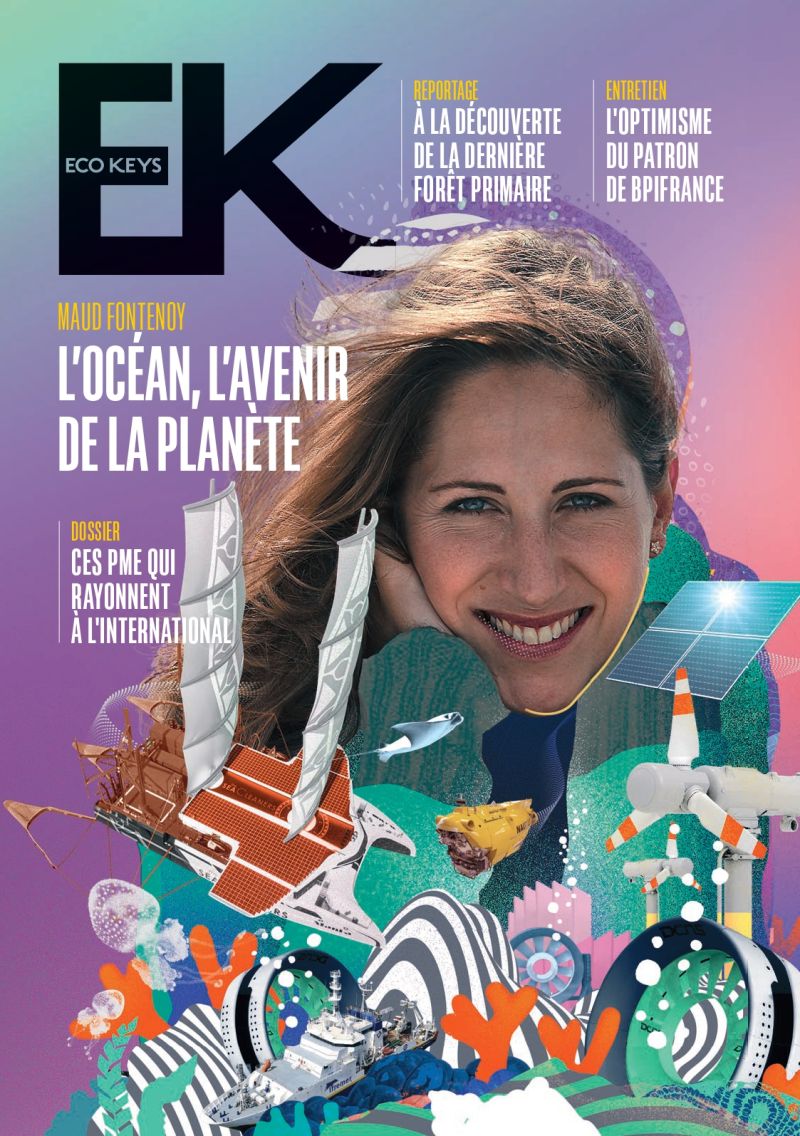
ECO KEYS volume 2 is out!

Discover the 2nd issue of ECO KEYS, the magazine of transformations created by our client EcoDDS in collaboration with Mascaret! 📖

In summary, you’ll find an interview with Maud Fontenoy telling us why oceans are the future of the planet, an interview full of optimism with the director of BPI France, Nicolas Dufourcq, as well as a report on the last primary forest of Europe 💡🌳🏭🌍

To discover an extract from this 2nd issue of ECO KEYS, click here!

Discover More

Top political influencers

On Sunday April 10, 22, the French moved to the various voting centers to decide who should become head of state, including nearly 5 million 18-24 year olds. Who are their political influencers?

A specificity emerged during this first round

Mobilization and participation of young people. And this, despite the higher abstention rate than 2017 (1st round: 22.2% in 2017, against 25.14% in 2022). When, at the end of March, the magazine Challenges and Mascaret revealed a ranking of the 10 best political influencers of the year, a majority of them were from the new generations and monopolized digital platforms. They analyze political news, subsequently touching on a new, younger segment that is usually not very sensitive to certain themes.

The role of political influencers

This is the case of the young journalist Hugo Travers who, at barely 24 years old, has a YouTube channel – Hugo Décrypte – which exceeds 4,500,000 subscribers. He had already stood out during the 2017 presidential elections by interviewing the candidates. Since then, his notoriety and his legitimacy with the French have continued to grow, making him the youngest face of the free treatment of national and international news.

We also find in this ranking Tatiana Ventôse who uses the codes of social networks to inform her almost 300,000 subscribers on YouTube and Instagram, the excellent Clément Viktorovitch, political scientist, journalist, role player and expert in rhetoric who occupies the fourth place in the ranking, Pascal Boniface, famous director of the Institute of International and Strategic Relations (IRIS) and his school (IRIS SUP’), or even Jean Massie and Usul of Mediapart in the program Backseat, etc.

Youth and politics are no longer opposing terms.

Young people occupy an important place on the scene of political debate in France, a place they did not expect. For the majority, this success is the result of opportunities seized thanks to digital communication tools. The “younger generation” has long been considered apolitical, but the current paradigm exposes the obsolescence of such ideas. Youth and politics are no longer opposing terms.

It is therefore judicious to observe the impact of this new commitment of young people on the outcome of the presidential elections. Are we going to witness a drop in their participation when we know that their favorite candidate, Jean-Luc Mélenchon, will not be in the second round? This one obtained more than 30% of those under 35 years old, as for the reverse, the electorate aged at least 60 years old mainly focused on Emmanuel Macron. Are we facing a real intergenerational conflict? The role of political influencers will be key in the future.

Find the details of our inquiry by clicking on this link.

Discover More

Presidential election 2022 – second round: the latest opinion poll by Mascaret, Odoxa & L’Obs

On this morrow after the election, a look back at the Mascaret opinion poll of voting intentions for the second round of the 2022 presidential election! Discover our estimates in collaboration with Le Nouvel Obs and our partners at Odoxa.

It is therefore Emmanuel Macron and Marine Le Pen who will face each other on Sunday April 24, as we had estimated. We predicted 28% for the outgoing president (27.6% preliminary results) against 24% for the candidate of the Rassemblement National (23.4%). The margins of error for voting intentions are established at between plus or minus 1.4 and 3.1 points.

In the second round of the 2022 presidential election, french people would grant 54.5% of their votes to Emmanuel Macron against 45.5% to Marine le Pen.

But this lead is still just as fragile: only 41% of voters would vote for Emmanuel Macron against 34% for Marine Le Pen… the others (25% altogether) are still hesitating between these two candidates or a blank or null vote (record in sight with 15%). Game’s still on. The debate between the two rounds promises to be decisive.

In any case, in terms of sociology, two Frances will face each other. The “popular” categories (50% vs 28%) and 25-34 year olds (45%) will vote Le Pen more than Macron. Conversely, the wealthiest French (51% vs 30%) and the oldest (52% vs 22% among those over 65) will vote overwhelmingly for E. Macron rather than for Mr. Le Pen.

You can find all the figures below or on the Odoxa website.

Discover More

Presidential election 2022 – first round: the latest opinion poll by Mascaret, Odoxa & L’Obs

On the eve of the election, Mascaret reveals its opinion poll of voting intentions for the 2022 presidential election! In collaboration with Le Nouvel Obs and our partners at Odoxa. As abstention threatens tomorrow’s election, you will find in our report the main trends observed in the electorate a few days before this vote, as well as our analysis of social networks:

Largely ahead of his main “rival” on social networks, the outgoing President is also criticized for his tightening of social screws

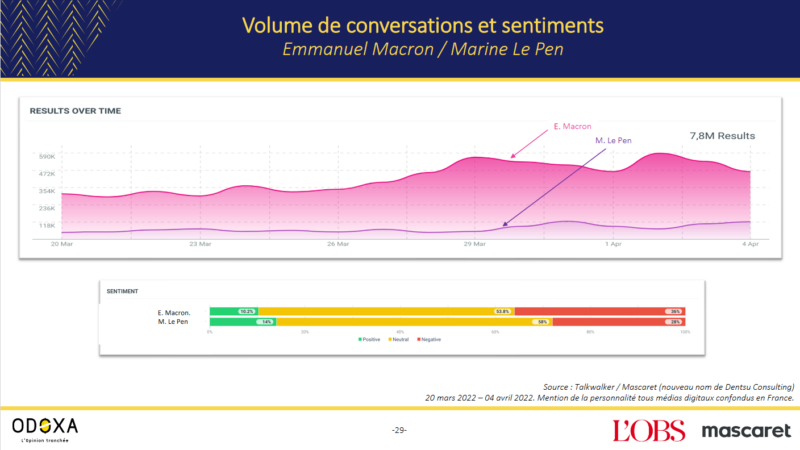
“Emmanuel Macron has accumulated 6 million mentions over the last 15 days, where Marine Le Pen hardly reaches one million. In terms of commitments, it even has 10 times more results (20.6 million VS 2.4 million). This means that the media publish more about President Macron (obviously, announcement effect, meeting, Ukraine, McKinsey, etc.), but above all, that Internet users discuss it a lot more (and debate it!). Announcements and publicity stunts on the social (learning, retirement, RSA, etc.) in particular, are hotly debated but because they went very badly: we observe significant peaks after his declarations but, above all, the feeling negative towards Emmanuel Macron is greater than that towards Marine Le Pen (36% VS 28%)! than 16,000 tweets in one day, while the Republican “dam” is only mentioned in derision…
Opponents from both right and left rush to Marine Le Pen to capture her electorate, but without much success.

Opponents from both right and left rush to Marine Le Pen to capture her electorate, but without much success.

The candidate of the National Rally remains difficult to hear on the networks, Éric Zemmour steals a lot of space for expression and online communities. A few exceptions, however, such as the publications of Hugo Décrypte which are always very successful. It is moreover Marine Le Pen who is the most targeted by the competition – from all sides – her rivals hoping to steal her place hitherto “acquired” in the second round. On his right, the Zemmour phenomenon aims to represent hard right tendencies there, and on his left, a real Mélenchon dynamic is accelerating in this final straight… but it is difficult to know if he will succeed in seducing not only historical voters on the left, but also the popular electorate recovered by the National Rally over the past twenty years. »

A big thank you to Gaël Sliman and the entire Odoxa team, as well as to our partners at the Nouvel Obs for this titanic work on the 2022 presidential election. We hope to have been able to shed some light on the eve of this decisive vote. for our common future.

To find the details of the figures and all of our analyses, you can download the complete study below or on the Odoxa website.

Discover More

Top influencers science

Challenges revealed the details of its “Influencers” report written in collaboration with Mascaret! This week, science is in the spotlight 🔭🧬

We are very proud to be able to share this top 10 with you. Non-exhaustive, it pushes forward great scientific figures, but above all, to popularizers! Of course, there are the all-important Thomas Pesquet and Jean-Marc Jancovici, as well as Fred Courant for L’Esprit Sorcier. We wanted to highlight the creators of new generation content.

Thus, it is the excellent Romain “Monté” Filstroff from Linguisticae, the unusual Patrick Baud from Axolot, Léo Grasset from Dirty Biology or even Marion “Professor Moustache” Montaigne who come to dot this ranking. All these science influencers have greatly contributed to the better dissemination of scientific knowledge!

Read the full article by clicking here.

Discover More

What impact for the McKinsey scandal on the french presidential election?

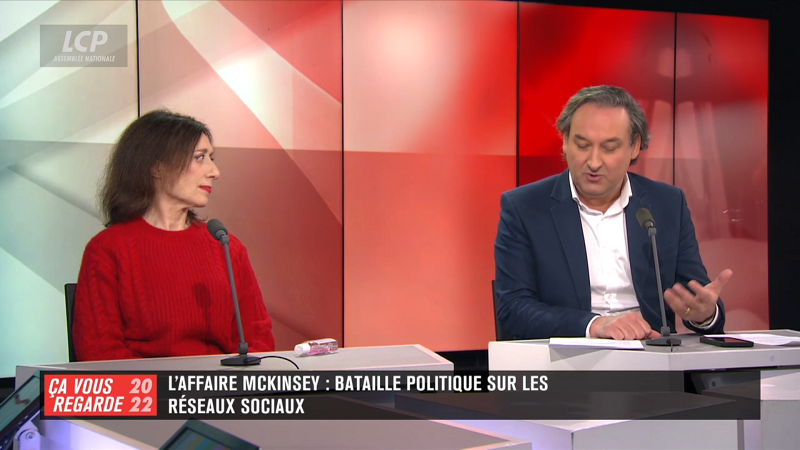
A look back at Benjamin GRANGE‘s analyzes of the McKinsey scandal on the eve of the 2022 presidential elections. Presented by Myriam Encaoua on the program Ça Vous Regarde on LCP (La Chaîne Parlementaire) and alongside Lasserre Isabelle, Journalist for Le Figaro. We find a decryption of all the information that upsets the last days of the French presidential elections of 2022.

Both sources of information and distribution channels, social networks are now essential elements of any electoral campaign. These allow candidates to challenge, get people to talk about, and then vote, a larger and more diverse audience than usual.
And given the mass of reactions produced by digital communication tools, it is impossible for certain political figures – who have still not decided on the candidate for whom they will sign, like Nicolas Sarkozy -, to escape multiple questions from the public and the press. What should be understood from the latter’s silence on his “favorite candidate” for the supreme magistracy?

“The McKinsey scandal: a blessing for the opposition”

Immediacy being essential on social networks, the mass of information produced testifies to the vigor of the public for the subjects. This makes it possible to base a judgment on the candidates for the positions of president. This is the case, for example, with the McKinsey scandal, which “poisoned Macronie” with its #McKinseyGate arising on the eve of the departure of the French for the polls. What consequences can this political scandal have in our current context?

For Benjamin Grange, this case represents “blessed bread for all opponents of Emmanuel Macron. Political opponents from all sides pounce on it and it is they who ultimately manage to score the most points. Similarly, he deplores the unfair juxtapositions of certain opponents, in particular Philippe de Villiers, whom he quotes during his speech. “Instead of talking about consulting firms, he talks about ‘private pharmacies’. We can clearly see where he wants to go. He tries to highlight one thing: the taxpayer pays twice. Once for senior officials and once for McKinsey consultants. It obviously puts the 2 populations in the same basket…”.

To follow his entire speech, you can watch the program again by double clicking below.

https://dai.ly/x89dckb
Discover More

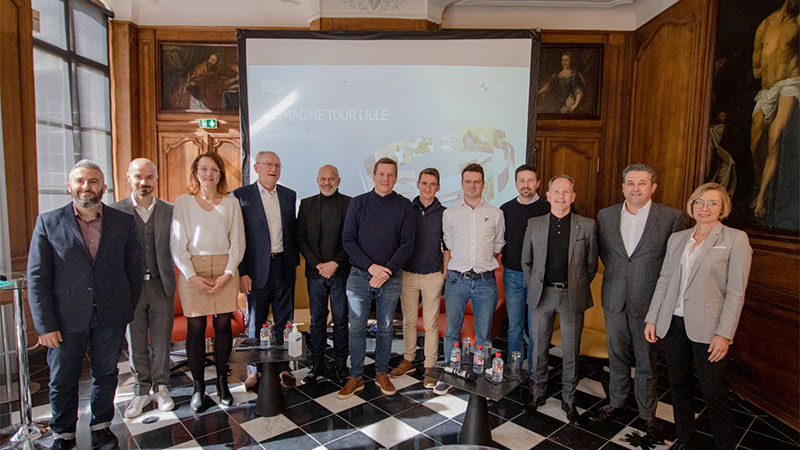
RE:IMAGINE TOUR – 5th stop in Lille!

If multimodality is the rule, environmental concerns around mobility are divisive! Alternately followers of public transport, cycling or motorized two-wheelers, in the Northern capital, 92% of Lille residents use the car, including 73% who take the wheel several times a week, and even 44% every days. At the same time, the bicycle boom, pedestrianization of the city center, low emission zones (ZFE), the inhabitants of Lille and the inhabitants of the Hauts-de-France region seem to be ahead of the challenges of sustainable mobility, even if certain subjects divide them. more than others.

Invited to participate in the debates and to speak on the future of the automotive sector, a structuring sector in this territory, Xavier Bertrand, President of the Hauts-de-France region, notably delivered his vision of the energy and environmental transition. of the mobility sector: “a necessary transition but which must be accessible to the middle and working classes”.

Discover the lessons learned from the final stage of the RE:IMAGINE TOUR, our mobility tour of France.

👉 https://bit.ly/3Le9z9u

Thank you to our speakers for their enlightened opinions!

Discover More

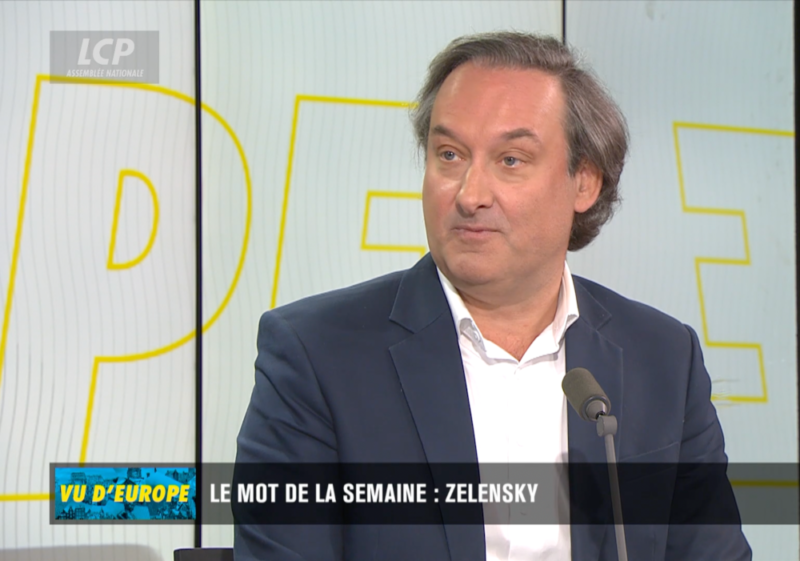
Zelensky in front of the European parliaments

We shared our weekly analysis of European news with you on the Vu d’Europe program of LCP. Alongside Brigitte Boucher, Marc Bassets, correspondent for El Pais, and Alex Taylor European journalist for France Inter, Benjamin GRANGE reviews the reactions to the intervention of the Ukrainian president in Parliament:

“On socialmedia, we talk about Ukraine and we talk about Zelensky. An unmistakable figure is 3.6 million requests in Europe over the last 30 days, i.e. 1,000 times more than over the same period last year!

However, as the mentions are down since the beginning of the conflict, President Zelensky is using drastic means to prevent Ukraine from being a conflict whose media coverage would be passive, frozen, like what we have been able to see in Syria, Yemen or Ethiopia. If we want to use, as Zelensky does, communication as a weapon of war, we must ensure that the conflict remains in the minds of European populations.

It does not take more to trigger an operation of ‘media rearmament’. The effect is immediate: the conversation curves in Italy, Germany or France peak after each of his respective interventions. If the operation appears successful at first sight, generating moments of European communion, the phenomenon is ‘pschit’, lasting only one day before returning to normal. Even the great figures invoked (destruction of Genoa, the Berlin Wall, Verdun) did not hit the mark on social networks. „

Find our full analysis in the replay of the show here!

https://dai.ly/x89dckb
Discover More

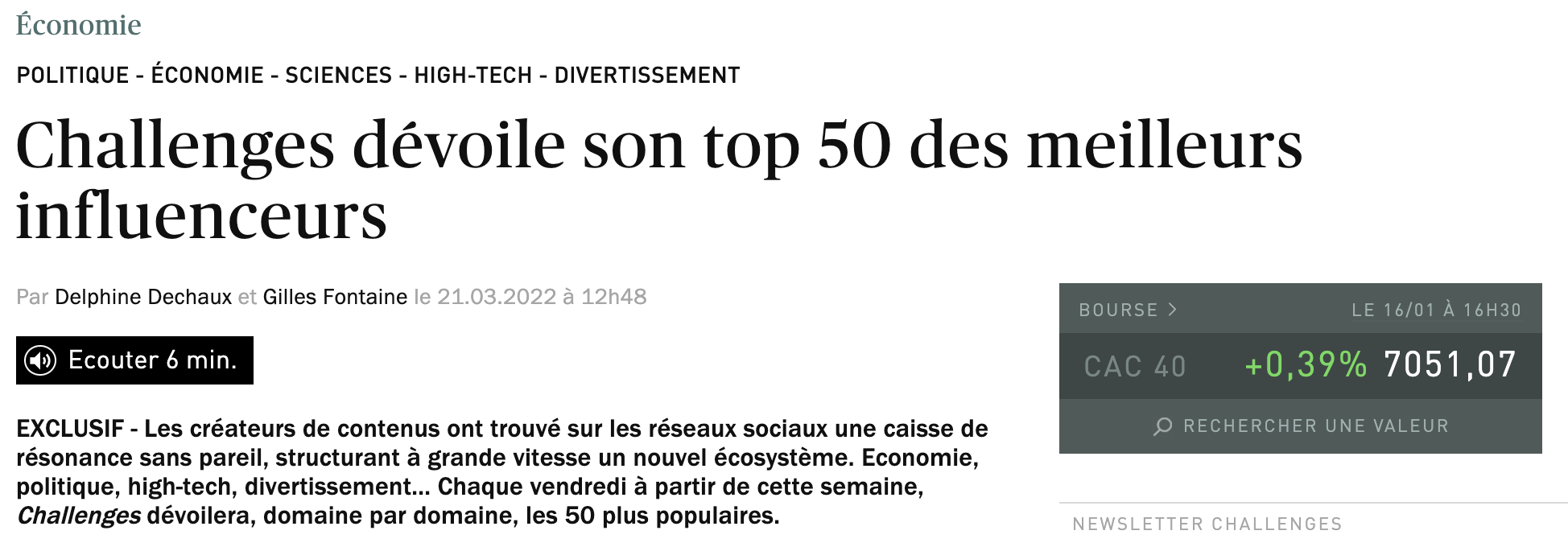
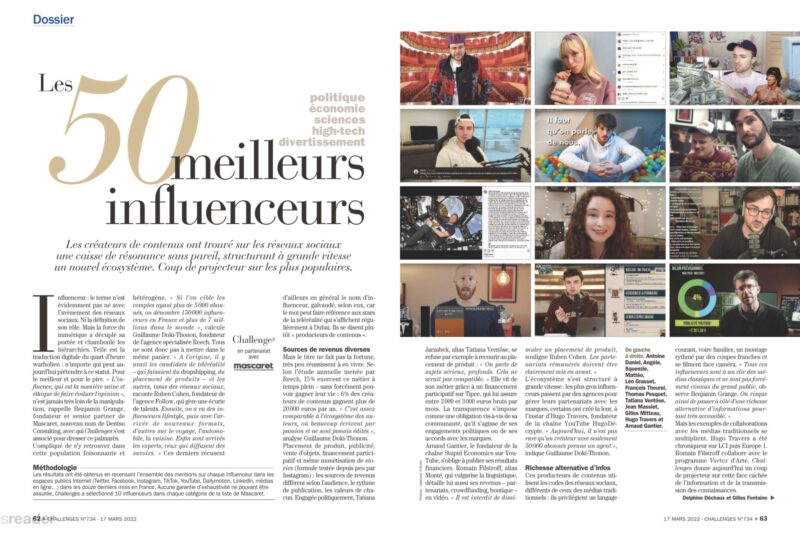
Challenges and Mascaret collaborate for a special report on “Influencers”

🎉 We are honored to have been able to collaborate with the Challenges teams in the development of this file! 🎉

From Jean Massiet to Thomas Pesquet, find your favorite influencers exclusively or discover new ones in this top 50 established by our firm. Economy, science, politics, high-tech and entertainment: they are all there.

https://www.challenges.fr/economie/exclusif-challenges-devoile-son-top-50-des-meilleurs-influenceurs_805156

Discover More

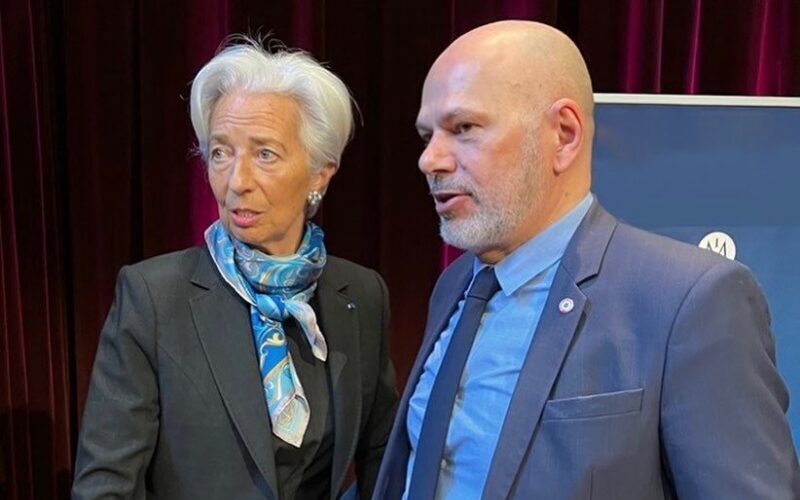
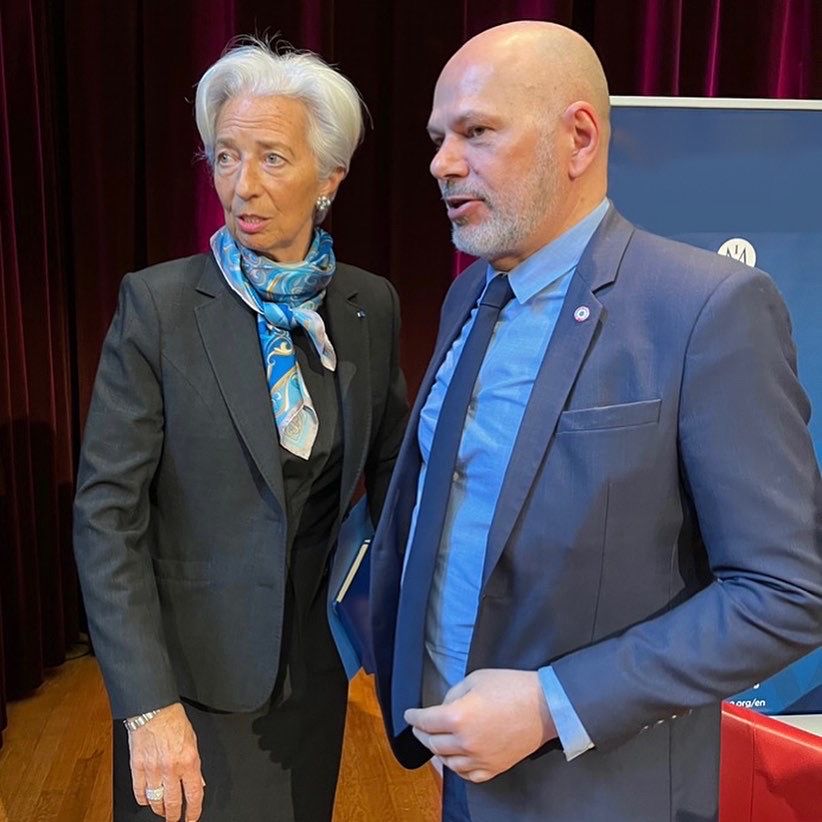
Meeting Christine Lagarde

Crises follow one another… but are not alike. Yves Censi, a senior partner at Mascaret, met Christine Lagarde at the Montaigne Institute for a Q&A session. He gives us more details:

“I met up with a still-as-always brilliant Christine Lagarde on Monday to discuss the inflationary context, the economic and monetary consequences of the global double shock of Covid and the ukrainian conflict, as well as the awaited role of the European Central Bank. Redistribution of access to resources and raw materials upsets our paradigms of growth, consumption and sovereignty. In particular: social inequalities and the standard of living.

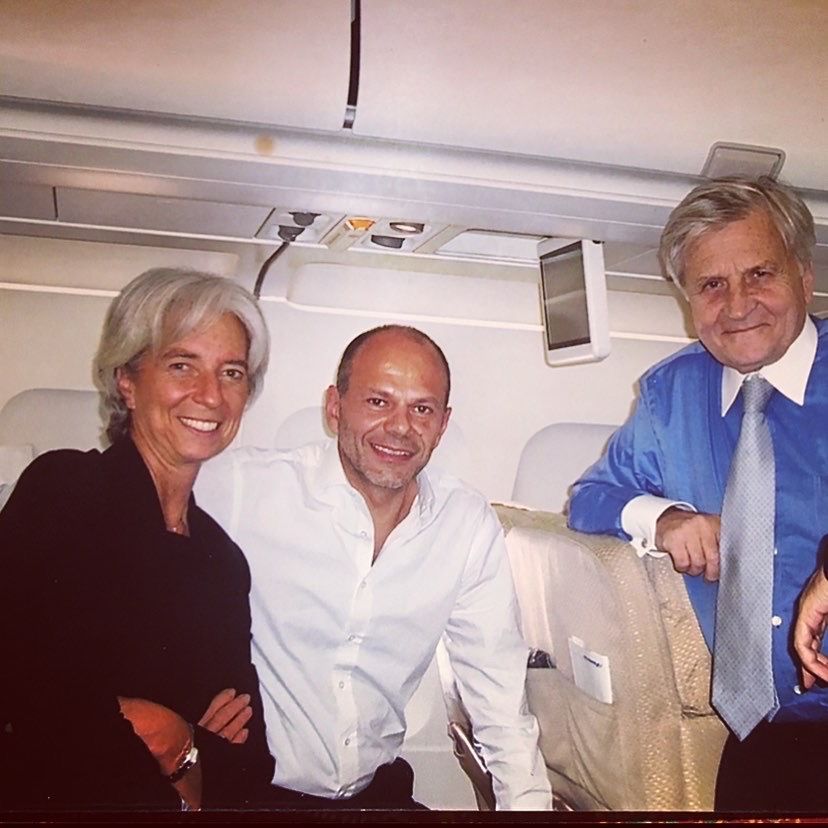
The second photo dates from September 2008, “black Monday”, when we were returning, with the President of the ECB at the time, Jean Claude Trichet, from Washington where we had just witnessed the bankruptcy of Lehman Brothers. The latter had precipitated the planet into the worst economic crisis since the 1930s. The obsession was on the reduction of sovereign debt, which is clearly taking a back seat nowadays.”

Discover More