Social media sees rising energy crisis worries

Yves Censi, senior partner of Mascaret (formerly Dentsu Consulting), was present on the set of Tech & Co, the BFM program, to present the results of our innovation barometer in collaboration with ODOXA. Read the details of our analysis, this month on the subject of the perception of the energy crisis by the French:

The energy crisis has social networks on edge

With the end of summer and the drop in temperatures, the spectre of a winter without heating has taken hold of the networks. Over the last 13 months, we have seen half a million mentions and more than seven million engagements on the subject of the energy crisis. Rates that are nothing extraordinary. However, half of these volumes have been made since August 15!

It is therefore a real explosion of conversations and debates that we observe: an increase of 500% that betrays the concern of the French. Indeed, when we look at the details of these publications, we discover that the majority (50.6%) of these contents are negative. This is a particularly high rate that is only equaled by other moments of major crises: rising gas prices, political controversies…

French people feel little confidence

The debates are all the more heated as they affect Internet users very closely. As everyone is aware of the global causes of this situation, many are seeking to regain control of this state of affairs. Politicians normally play this role, but when they do speak out on the subject, they are not the most listened to or relayed. The few times that the public picks up on their messages, it is to criticize them. In particular, government announcements offering advice on how to reduce energy consumption: these are very badly received by Internet users, who feel guilty. The controversy surrounding private jets is proof of this: with a 300% increase in volumes since this summer, which are also largely negative, this is a symbolic expression of French people’s unease.”

CLICK HERE TO WATCH YVES CENSI’S FULL INTERVENTION.

Discover More

Mascaret opens its new offices in Dubai

September 22, 2022 – Mascaret (formerly Dentsu Consulting), France’s leading business communications firm, is opening an office in Dubai, in the United Arab Emirates to accelerate the development of its activities in the Middle East and Africa. 

This opening is part of Mascaret’s international expansion strategy, already present in 12 countries through its proprietary network (M+M Gate).

The Dubai office will be managed by Reza Sadri, Senior Partner, who has been working for 20 years on major transformations in technology, particularly for public and private players in the Middle East. “Mascaret’s expertise in business communications is particularly well suited to the Middle East business ecosystem. I am delighted with this new location in Dubai, which will accelerate the deployment of our roadmap to become a reference consulting firm in the Gulf region” says Reza Sadri.

MASCARET UAE

Office 430, Building B – Al Saaha Offices – Burj Khalifa District – P.O. Box 487177, Dubai, UAE


Discover More

What is a mascaret?

What is a mascaret, otherwise called a “tidal bore”? Not all of our partners may know that this is not a word we made up from scratch, but a rare and highly symbolic phenomenon! 🌊🌊🌊

Those of you who are from the southwest may already be familiar with the mascaret. This phenomenon can be observed in certain regions where, at each tide, a sudden wave forms at the mouth of a river or a stream (the Gironde for example!). This wave will then go up the river against the current, and this, sometimes on more than 100km! The surfers then have a great time and enjoy this experience by letting themselves be carried by this unique wave 🏄♂️🏄♂️🏄♂️

A beautiful symbol of the values we carry!
#mascaret #newbusiness #brandinginspiration

Discover More

Business has become politics: Benjamin Grange’s column for Forbes

Senior partner and CEO of Mascaret (formerly Dentsu Consulting), Benjamin GRANGE reveals the content of his latest article for Forbes France: “The company has become political”.

The rise of stakeholders, the ESG approach, Covid19, the Russian crisis, … have strongly politicized the way companies manage their external relations

Internal politics has always been part of the company. In its positive sense, it consists in being diplomatic, in the art of promoting decisions, in presenting situations as well as possible internally. But in recent years, and with an acceleration since 2020, events have forced companies to go further. In its definition, politics is mainly about the collective. It concerns the actions, the balance, the development of the society in which we live, in all its aspects. For the company, politics is about the capacity to generate its externalities and to take clear positions towards society. For a long time, the company remained focused on its shareholders, whose growth and return it had to serve. It thus avoided interfering in matters relating to political parties, the geopolitical situation or public debates when this did not directly threaten the continuity of its operations.

Today, in an accelerated world where the transformation of the notion of authority, the systematic relativization of points of view, the multipolarity of decision-making centers, the versatility of communities of interest on the Internet, etc., mean that we have moved from the era of claimed expertise to the era of assumed influence, the company has been led to become a political player. Without limiting the personal impetus given by certain managers, pressure from customers, NGOs and civil society has forced the company to be curious and to make commitments in the management of its potential externalities: climate transition, production ethics, diversity, etc. By becoming aware of its interactions with society, the company has gradually become more political. As a direct consequence, it has begun to display its struggles, as illustrated by its status as a company with a mission or B-Corp. With Covid19, the company became a relay for the public authorities, offering services that the State had difficulty providing: purchase of masks, manufacture of gel, etc. Since then, the war in Ukraine has opened up the field of geopolitics: withdraw from Russia, leaving almost everything behind before the economic sanctions, or stay and be accused of not playing Europe’s game. Because if the company has become political in its relations with the outside world, it is also playing politics more and more. Total Energies chose to maintain its activity in Russia during the first months of the war. The consequence was twofold: significant profits and a new reputational issue, even prompting Antonio Guterres, Secretary General of the United Nations, to call for a tax on the excess profits of energy companies. At the same time, soaring fuel prices have generated intense mobilization of public authorities to implement measures to support purchasing power. Air transport and its customers have been singled out for the level of CO2 emissions, while industries that emit much more are the symbol of what needs to be relocated. Today, with the concept of sovereignty applied to private actors, relations are oriented towards certain “friendly” countries or countries reputed to be so, to the detriment of others. Another political choice! This situation raises a question of organization for the company. Who is responsible for managing this political management?


To find all our analyses on this subject, go to our website or directly to the pages of Forbes!

Discover More

Climate: tech raises hopes

Technology in the face of global warming: what is the position of the French? Find Yves CENSI‘s answer in its entirety when the replay is published on BFMTV!
 
Faced with the threat of climate change, #innovation is one of the main levers for reducing greenhouse gas emissions. Whether it’s renewable energy, electric cars or all forms of energy efficiency, low-carbon #technologies cover a wide range of sectors. These technologies offer more hope to people who trust green tech to meet the challenges of the climate and energy transition.  
 
As every month, Mascaret (formerly Dentsu Consulting) with its partners ODOXA and Leyton, present a political barometer analyzing the opinion of the French on one of the key topics of the public debate. In this study, we learn that the French expect a lot from the world of innovation and technology. For 72% of respondents – 5% more than two years ago – technological progress has been made. This is undoubtedly one of the least controversial and least divisive topics in France. 

Yves Censi, Senior Partner Mascaret, Emile Leclerc, Director of Research at ODOXA and Alexandre Charles Touret, Marketing Director for Leyton France, discussed the topic “Climate: tech raises the hopes of the French” in the Tech & Co Business program presented by Frédéric Simottel.

CLICK HERE

Discover More

Combining economic sovereignty and economic freedom: Benjamin Grange’s column for Forbes

Benjamin Grange, Senior Partner at Mascaret (formerly Dentsu Consulting) published an article in Forbes France on July 19, 2022. It deals with the relationship between economic sovereignty and economic competition.

Indeed, while there is talk of de-globalization, the economic sovereignty of States is increasingly interfering in the game of free competition.

According to Benjamin GRANGE, “Without a common definition in Europe, and without truly public doctrines of national intervention, the framework for action given to economic actors remains uncertain, generating a risk for those who wish to act without offending.


A concept that is increasingly in vogue at a time when there is talk of de-globalization, sovereignty interferes in the game of free competition by creating one more uncertainty for economic actors.

In a world where economic competition is the norm, the game of pure and perfect competition is sometimes deviated by tacit or implicit practices that distort the competitive game to an extent that harms a country’s economy, its sovereignty or the security of its population. Let’s take the start-up XYZ, which excels in advanced technology (space, quantum, cybersecurity, biotechnology, etc.). It is currently seeking more than €100M. Several non-European funds are approaching it with, beyond financing, a desire to recover the technology. Under the guise of financing, it is in fact an act of economic predation, often characterized after the fact.

In another register, since the end of the 1990s, we have witnessed a proliferation of laws with extraterritorial scope, particularly of American origin. The “Discovery” procedure offers any party to a legal action brought before a non-US court the possibility of obtaining from the US judge the forced production of evidence held by any party on US territory, provided that the evidence in question is intended to be used for the purposes of the foreign proceedings. This is all it takes to serve as a lever of economic intelligence by requesting the production of all or part of documents or information normally protected by business secrecy. This abuse of extraterritorial laws has become an instrument of American foreign policy, and has grown in scope since 2001. Of the 26 companies condemned: 14 European and 5 French. No Chinese or Russian companies were convicted.

A French car manufacturer that sold nearly 450,000 vehicles in Iran yielded to the injunction of the Trump administration, which threatened retaliation against foreign companies doing business with Tehran, namely financial sanctions and eviction from the American market.

We can therefore understand the emergence of the concept of industrial and technological sovereignty. Close to economic security, it is defined as the materialization of a state policy aimed at protecting and promoting the strategic interests of a nation. Used very widely, even too much so since the beginning of de-globalization, it brings together the activities of protection of heritage, delimitation of critical industrial and technological perimeters and the fight against foreign economic intelligence activities. This is the difficulty linked to the subject of sovereignty. At what point does free competition stop and at what point does the act of economic predation that requires action begin? For the moment, it remains a question of national interpretation and of the regalian state of mind at the time the situation arises. The stronger the national feeling or the higher the interdependence with other countries, the more acute the will of a country to intervene, to discourage a priori or to block a posteriori. Without a common definition in Europe, and without really public doctrines of national intervention, the framework of action given to economic actors remains uncertain, generating a risk for those who want to act without offending, to deploy themselves serenely. This is one more uncertainty at a time when we are talking about de-globalization.

Benjamin GRANGE

CLICK HERE TO DISCOVER THE FULL ARTICLE

Discover More

First seminar by Ambitious Finance

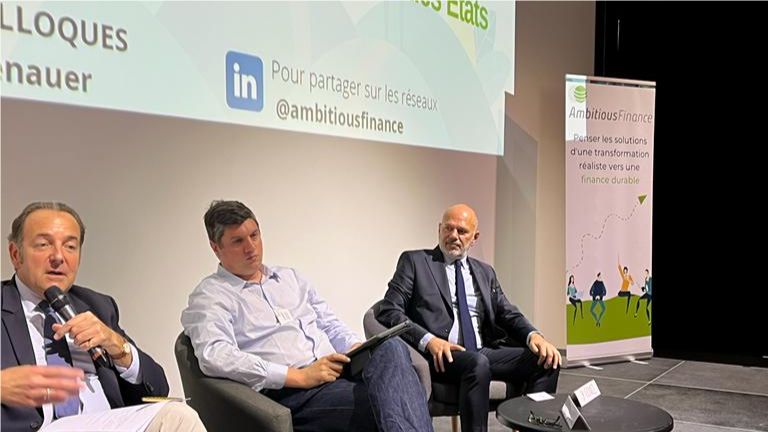
Yves CENSI, Senior Partner at Mascaret (formerly Dentsu Consulting) introduced, on July 6th, the panelists called to debate within the framework of the seminar of decision makers in #Banking – #Finance – #Insurance. This seminar organized by the independent think tank Ambitious Finance by AILANCY, welcomed many talents from our partners Finance for Tomorrow, WBCSD – World Business Council for Sustainable Development, Novethic and RSEDATANEWS.

The seminar was held in several stages at the Cité Internationale Universitaire de Paris, each one addressing different aspects of sustainable economics and finance. Yves Censi chaired the very first Ambitious Finance round table, the theme of which was “Sustainable finance: between accelerating challenges for the financial sphere and cautious action by states”. He was joined by our collaborators Alexandre Malafaye – Founder of Synopia, Jean Boissinot – Secretary General of the Network for Greening the Financial System (NGFS) and Arnaud Dumas, Editor of Novethic Essentiel.

Why sustainable finance? The financial sector plays a driving role in the functioning of the economy: financial flows allow the collection of available capital held by economic agents with a capacity to #finance (generally household savings) to make it available to agents with a need. The various financial #actors can therefore actively participate in a better orientation of #capital towards the financing of investments that have a positive impact on society in the medium and long term. In other words, sustainable finance can be an interesting solution to meet the major #ecological and #economic challenges of our time!

Discover More

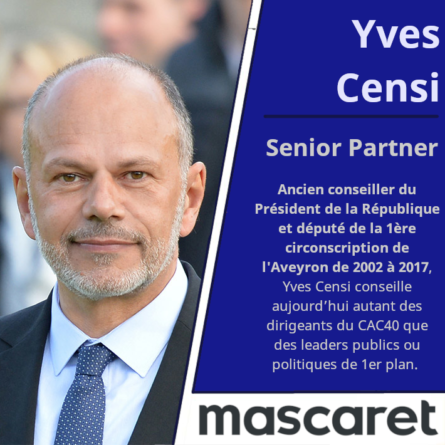
Yves Censi is appointed Senior Partner

Paris, June 30, 2022 – Mascaret, an independent consulting firm and leader in business communication, announces the arrival of Yves Censi as Senior Partner.

With more than 30 years of experience, the former MP will take charge of supporting major accounts and leading leaders. This new strategic recruitment is part of the rapid development of Mascaret, which wishes to position itself as a leader in strategic consulting for managers by strengthening its teams, both in France and internationally.

Yves Censi began his career as a consulting engineer in banking and finance organization at KPMG Peat Marwick Consultants before directing the marketing of online products for La Française des Jeux. Joining Jacques Pilhan, who had just democratized the profession of political communicator, in 1997 he became adviser to the President of the Republic Jacques Chirac at the Élysée Palace until 2002. Elected deputy for Aveyron from 2002 to 2017, vice-president of the Finance, General Economy and Budgetary Control Commission, he was also elected local, municipal and urban councilor of Rodez from 2014 to 2020. He is recognized for his expertise in political strategy and in the financing of the economy combining public and private funding.

Yves holds a Master’s degree in Labor Law from Panthéon Assas University, holds a DEA from ENS-EHESS (1990), auditor of the 2010 session of the Institute for Advanced Business Studies (IHEE), Young Leaders 2003 from the French-American Foundation. He is a frigate captain (H) in the citizen reserve of the French Navy.

“I am very proud to carry the values ​​of Mascaret and to participate in the development of its business consulting offer in the face of its new challenges. I have full confidence in all the teams to carry out the missions of relevant advice and effectively support the many clients. Today, we must meet the challenges of growth and performance in a constantly changing environment! »

Yves censi
Discover More

Opinion poll: the Executive breaks apart / Coalition, can France get into it?

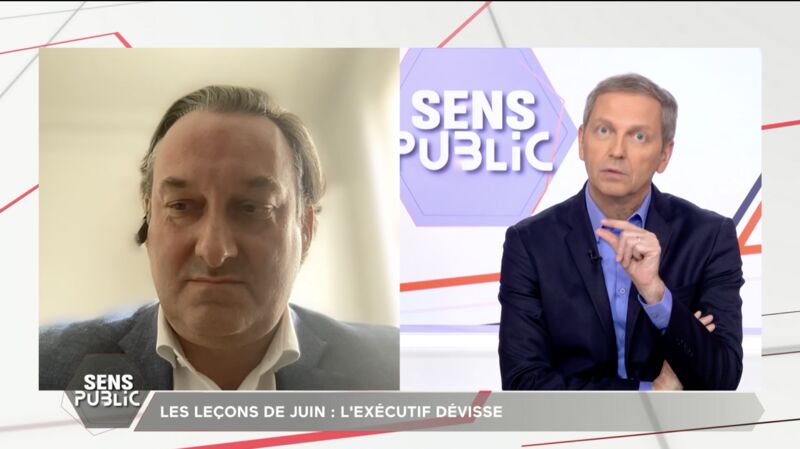
Benjamin GRANGE, senior partner of Mascaret, was present on the set of Sens Public for LCP to present the results of our political barometer about coalition-building, in collaboration with ODOXA.

This month, we look at the poll’s two main lessons: a struggling executive couple on one side, and a surge of RN and NUPES on the other. What to remember from this month of June rich in political events? Can our political class learn the art of compromise and coalition? How to reconcile relative majorities and political stability?

All these questions and many others are analyzed by a panel of experts who came to Sens Public, including Gael Sliman, president of Odoxa, Mathieu Souquière, essayist, Martin-Genier Patrick and Claire Chartier, journalist and essayist. Find the whole study on our website!

Discover More

The aftermath of the legislative election

Mascaret (formerly Dentsu Consulting) is partnering with ODOXA to bring you this month’s political barometer! Find all of our analysis of social networks in the aftermath of the legislative elections. In partnership with LCP-National Assembly, Public Senate and the #PQR.

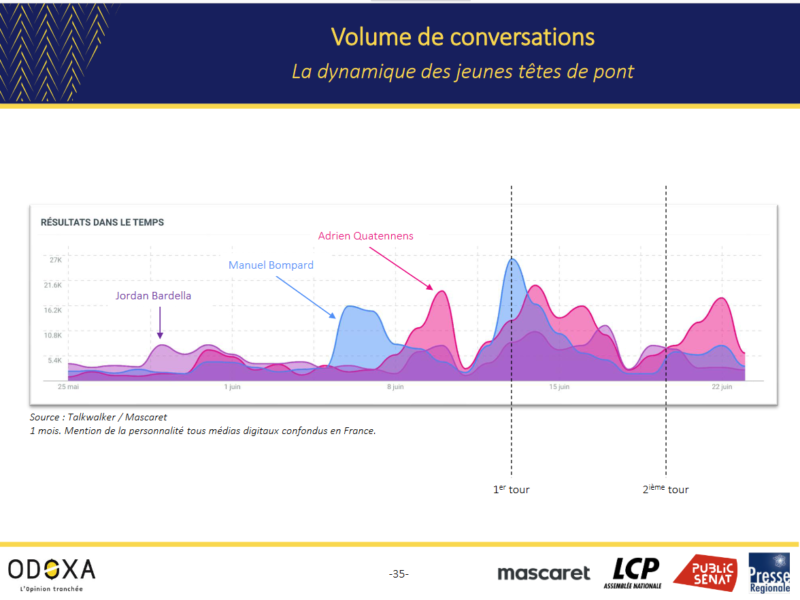
“We are seeing a heightened interest in parliamentary oppositions”, shares Benjamin GRANGE, senior partner at Mascaret, “As expected, the presidential candidates disappear from conversations for the most part. There is a return of the parliamentary political figure who had been discreet during the presidential elections. Notably, the dynamic is confirmed with their representatives – Adrien Quatennens, Manuel Bompard or Jordan Bardella – who explode on the networks: they are asked all the questions that go with their new political weight. »

Yves CENSI, also senior partner, adds: “Will the LRs be a political key for the opposition as for the majority? Many discover the new deputies NUPES and RN, it is to the tenors LR that the media tends the microphone. The unique position of majority (or opposition) maker has not gone unnoticed by Internet users. Xavier Bertrand, Laurent Wauquiez, Eric Ciotti… are at the heart of the questions of the French about their political direction for the post-legislative period. »

The entire quantified study is available on our website!

Discover More